Total solar eclipse of 22 July 2028
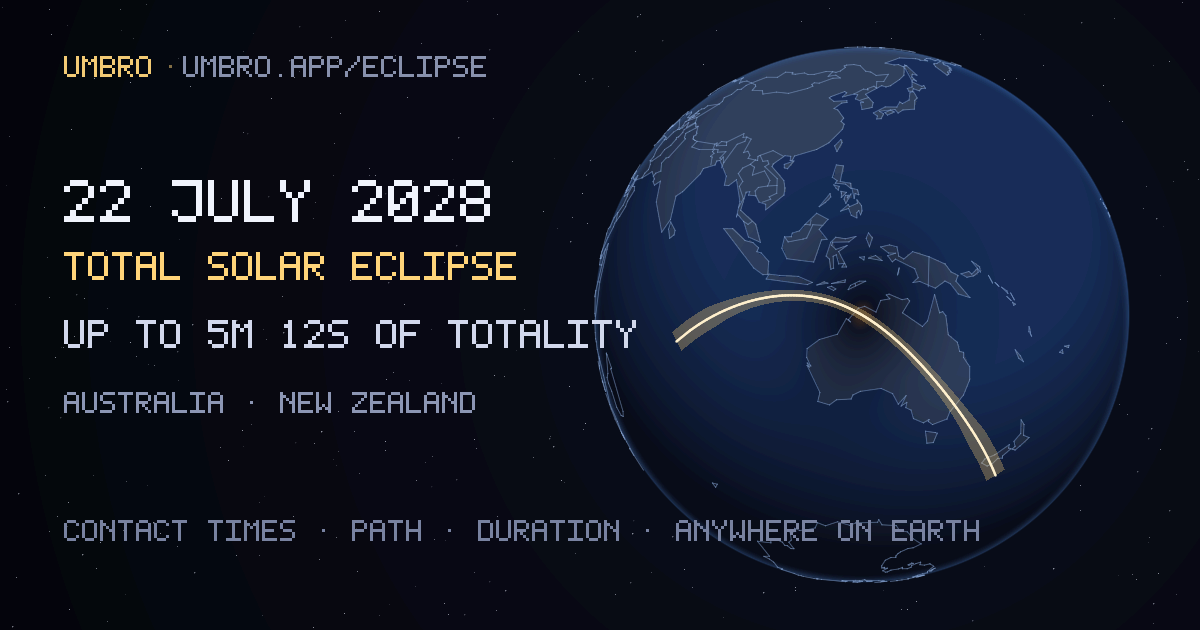
Up to 5 minutes 12 seconds of totality, along a band crossing Australia and New Zealand. Greatest eclipse falls at 02:55:45 UTC on 22 July 2028.
Open 22 July 2028 in the tracker The interactive map, the shadow at any moment, and the figures for wherever you are.
The numbers
- Type
- Total
- Greatest eclipse
- 22 July 2028, 02:55:45 UTC
- Longest totality
- 5 minutes 12 seconds
- Longest from
- 15.10°S 125.65°E, Australia
- Path width there
- 234 km
- Greatest eclipse over
- 15.62°S 126.61°E
- Shadow first touches the Earth
- 01:32:27 UTC
- Shadow leaves the Earth
- 04:18:27 UTC
- Gamma
- -0.6062
Where the path goes
The shadow touches the Earth at 01:32:27 UTC and leaves it at 04:18:27 UTC. In between, the umbra crosses Australia and New Zealand. Outside that band the eclipse is partial over a far larger area — several thousand kilometres either side — and the further from the line, the less of the Sun is covered.
- Australia
- New Zealand
In the order the shadow reaches them. A country is listed only where the total phase is genuinely visible from land within it, with the Sun above the horizon — not merely where the band comes close.
Cities on and near the path
Each of these has its own page, with first contact, the start and end of the central phase, maximum and last contact — in local time, worked out at the city's own elevation.
| City | Country | Maximum, local time | What is seen |
|---|---|---|---|
| Sydney | Australia | 14:01:51 GMT+10 | 3m 48s of totality |
| Kununurra | Australia | 11:01:38 GMT+8 | 2m 13s of totality |
| Tennant Creek | Australia | 12:50:11 GMT+9:30 | 2m 55s of totality |
| Bourke | Australia | 13:52:37 GMT+10 | 4m 10s of totality |
| Dubbo | Australia | 13:57:41 GMT+10 | 3m 57s of totality |
| Queenstown | New Zealand | 16:16:55 GMT+12 | 2m 57s of totality |
| Dunedin | New Zealand | 16:17:35 GMT+12 | 2m 51s of totality |
Looking at it safely
The Sun is as dangerous during a 99% partial eclipse as on any other day, and the remaining sliver is bright enough to burn a hole in a retina without hurting at the time. Certified eclipse glasses, or nothing. The one exception is totality itself — between second and third contact, when the disc is entirely covered, it is safe to look, and that is the only time. Umbro says which of those you are in, from the contact times where you are.
Carry this in your pocket
Umbro for iPhone and iPad computes these same contact times on the device, for wherever you are standing, with no signal needed — which matters, because a good many eclipses are best seen from somewhere without any. It adds a Lock Screen countdown, Home Screen widgets, a camera built for totality, and it says plainly when the Sun can and cannot be looked at.